BooksVol. 16New
Do I Need to Quit Drinking?
How to Drink Less or Stop Drinking Alcohol Safely: An Evidence-Based Guide Without Labels or Shame
by An Thanh Tùng
ASIN B0HP7YPM12 · B0HP7MCNZF
About this book
Drinking is not a switch but a dial.Chapter 1
A plain-language, evidence-labeled guide for adults who wonder whether they drink too much. Instead of labels, it offers a dial. Check your safety first, measure where you are with a ten-question screening test, then choose one of three roads, turning it down, turning it to zero, or calling in help, with plain guidance on safe withdrawal, medicines most people are never offered, support for families, a 30-day experiment and what comes after.
What you'll learn
- Ch. 2The 6 p.m. drink is a habit with a cueSlipping a ten-minute pause in front of it is far easier than fighting the wanting with willpower.
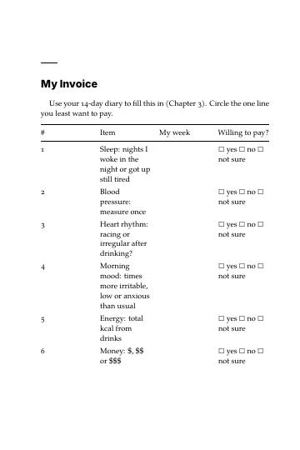
- Ch. 3Every week of drinking sends an invoiceSleep, blood pressure, heart rhythm, mood, money and time. Read it once, then choose what you no longer want to pay.
- Ch. 6You don't have to hit rock bottom“Alcoholic” is a spectrum, not a switch. Most people recover.
- Ch. 8Never stop suddenly if you shakeIf you need a drink in the morning, see a doctor first. With supervision, most people can withdraw safely at home.
- Ch. 9The medicines few people are offeredNaltrexone and acamprosate are well studied for drinking less or stopping. Ask your doctor directly.
- Ch. 13A slip is not a failureThe danger is the “I've blown it” thought. Write your slip plan in advance.
How the book is organized
- Part IWhy the Dial Is Where It Is
- Part IIReading the Dial
- Part IIITurning the Dial
Look inside
Pages from the book
- How to read this book
- Chapter 1 opens
- Every claim carries a label
- Try it at home
- If you remember one thing
- A printable worksheet
- Notes and sources
Free with your email
Worksheets from this book
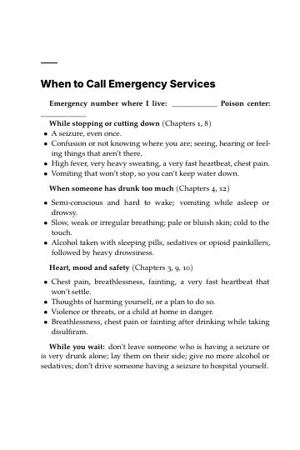
- Safety card When to Call Emergency Services Get the PDF
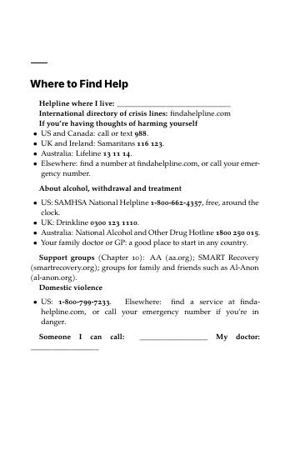
- Safety card Where to Find Help Get the PDF
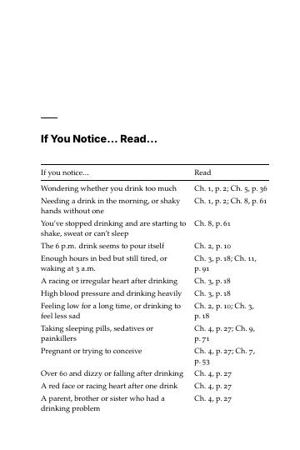
- Reference table If You Notice… Read… Get the PDF
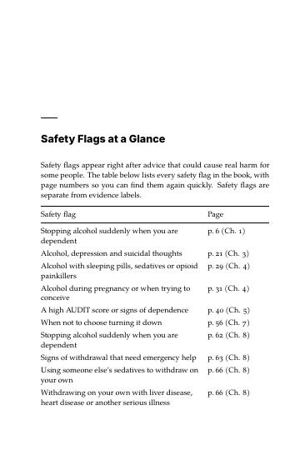
- Safety card Safety Flags at a Glance Get the PDF
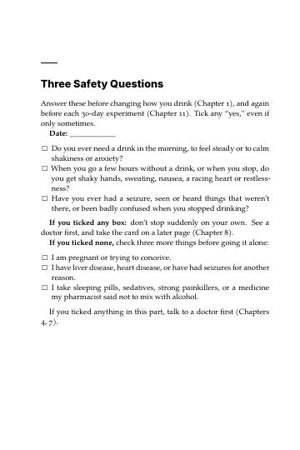
- Worksheet Three Safety Questions Get the PDF
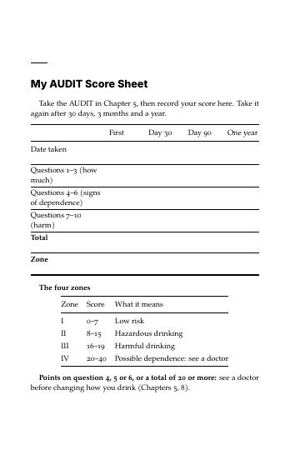
- Worksheet My AUDIT Score Sheet Get the PDF
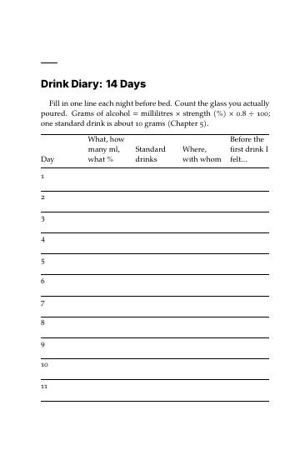
- Worksheet Drink Diary: 14 Days Get the PDF
- Worksheet My Invoice Get the PDF
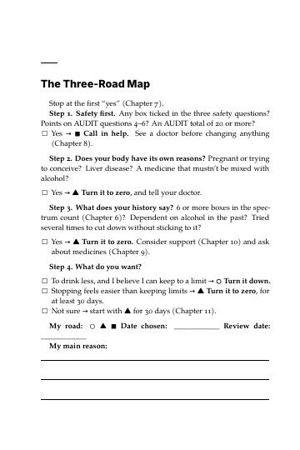
- Worksheet The Three-Road Map Get the PDF
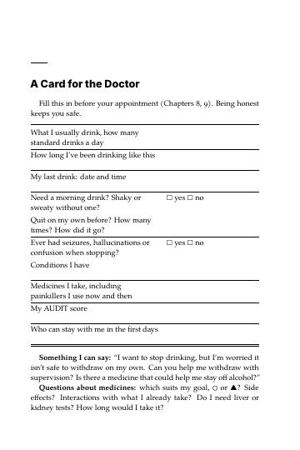
- Worksheet A Card for the Doctor Get the PDF
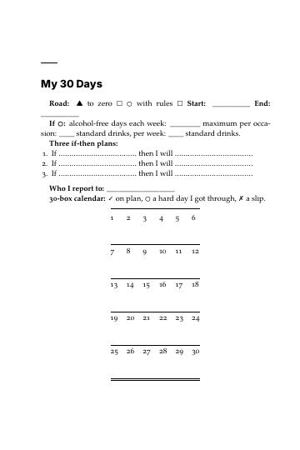
- Worksheet My 30 Days Get the PDF
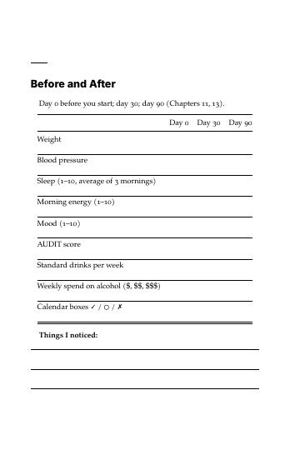
- Worksheet Before and After Get the PDF
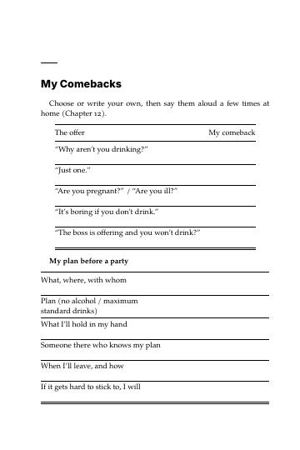
- Worksheet My Comebacks Get the PDF
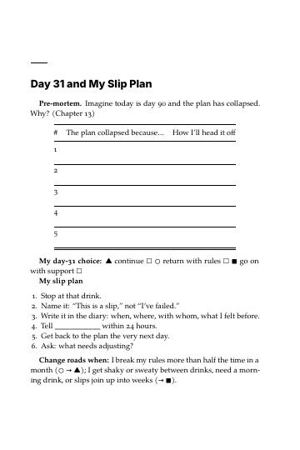
- Worksheet Day 31 and My Slip Plan Get the PDF
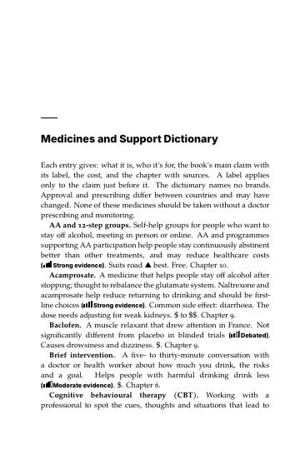
- Reference table Medicines and Support Dictionary Get the PDF
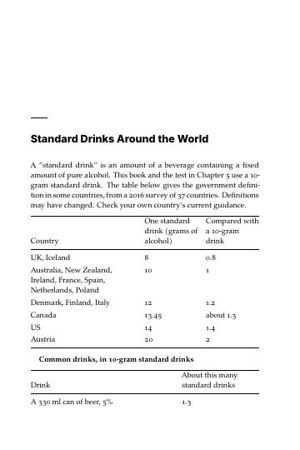
- Reference table Standard Drinks Around the World Get the PDF
83 references
Notes and sources
Ch. 1Do I Need to Quit Drinking?4
- Most excessive drinkers are not dependent Esser MB, Hedden SL, Kanny D, et al. Prevalence of alcohol dependence among US adult drinkers, 2009–2011. Prev Chronic Dis 2014;11:E206. doi:10.5888/pcd11.140329. PMID 25412029.
- Alcohol as a Group 1 carcinogen IARC Working Group on the Evaluation of Carcinogenic Risks to Humans. Personal habits and indoor combustions. IARC Monogr Eval Carcinog Risks Hum 2012;100E:1–538.
- Alcohol and cancer risk Office of the US Surgeon General. Alcohol and Cancer Risk: The U.S. Surgeon General's Advisory. Washington, DC: US Department of Health and Human Services; 2025.
- Withdrawal when someone dependent stops suddenly American Society of Addiction Medicine. The ASAM clinical practice guideline on alcohol withdrawal management. J Addict Med 2020;14(3S Suppl 1):1–72. doi:10.1097/ADM.0000000000000668. PMID 32511109.
Ch. 2The 6 p.m. Drink7
- Alcohol and dopamine in the human brain Boileau I, Assaad JM, Pihl RO, et al. Alcohol promotes dopamine release in the human nucleus accumbens. Synapse 2003;49(4):226–231. doi:10.1002/syn.10226. PMID 12827641.
- Wanting and liking Berridge KC, Robinson TE. Liking, wanting, and the incentive-sensitization theory of addiction. Am Psychol 2016;71(8):670–679. Search PubMed
- Brake, accelerator, tolerance and rebound ASAM 2020. See Chapter 1.
- From goals to habits Everitt BJ, Robbins TW. Drug addiction: updating actions to habits to compulsions ten years on. Annu Rev Psychol 2016;67:23–50. Search PubMed
- Does willpower run out? Hagger MS, Chatzisarantis NLD, Alberts H, et al. A multilab preregistered replication of the ego-depletion effect. Perspect Psychol Sci 2016;11(4):546–573. Search PubMed
- Four reasons for drinking Cooper ML. Motivations for alcohol use among adolescents: development and validation of a four-factor model. Psychol Assess 1994;6(2):117–128. Search PubMed
- Why people drink, and what follows Bresin K, Mekawi Y. The "why" of drinking matters: a meta-analysis of the association between drinking motives and drinking outcomes. Alcohol Clin Exp Res 2021;45(1):38–50. doi:10.1111/acer.14518. PMID 33206387.
Ch. 3What Alcohol Takes6
- Alcohol and sleep Ebrahim IO, Shapiro CM, Williams AJ, Fenwick PB. Alcohol and sleep I: effects on normal sleep. Alcohol Clin Exp Res 2013;37(4):539–549. doi:10.1111/acer.12006. PMID 23347102.
- Cutting down and blood pressure Roerecke M, Kaczorowski J, Tobe SW, et al. The effect of a reduction in alcohol consumption on blood pressure: a systematic review and meta-analysis. Lancet Public Health 2017;2(2):e108–e120. doi:10.1016/S2468-2667(17)30003-830003-8). PMID 29253389.
- Abstinence and atrial fibrillation Voskoboinik A, Kalman JM, De Silva A, et al. Alcohol abstinence in drinkers with atrial fibrillation. N Engl J Med 2020;382(1):20–28. doi:10.1056/NEJMoa1817591. PMID 31893513.
- "Holiday heart." Ettinger PO, Wu CF, De La Cruz C Jr, et al. Arrhythmias and the "holiday heart": alcohol-associated cardiac rhythm disorders. Am Heart J 1978;95(5):555–562. Search PubMed
- Alcohol and depression Boden JM, Fergusson DM. Alcohol and depression. Addiction 2011;106(5):906–914. doi:10.1111/j.1360-0443.2010.03351.x. PMID 21382111.
- Blood pressure thresholds Whelton PK, Carey RM, Aronow WS, et al. 2017 ACC/AHA guideline for the prevention, detection, evaluation, and management of high blood pressure in adults. Hypertension 2018;71(6):e13–e115.
Ch. 4Not Every Body Drinks the Same6
- Women and alcohol National Institute on Alcohol Abuse and Alcoholism (NIAAA). Women and Alcohol. Fact sheet; updated 2025.
- Older adults and alcohol NIAAA. Aging and Alcohol. Updated 2025.
- Alcohol and medicines in older adults Holton AE, Keeney C, Ryan B, et al. Prevalence of potentially serious alcohol-medication interactions in older adults in a community pharmacy setting. BMJ Open 2020;10(8):e035212. doi:10.1136/bmjopen-2019-035212. PMID 32868351.
- Genes and alcohol use disorder Verhulst B, Neale MC, Kendler KS. The heritability of alcohol use disorders: a meta-analysis of twin and adoption studies. Psychol Med 2015;45(5):1061–1072. doi:10.1017/S0033291714002165. PMID 25171596.
- Alcohol in pregnancy Centers for Disease Control and Prevention (CDC). About Alcohol Use During Pregnancy. Atlanta, GA: CDC; 2024.
- ALDH2 and flushing See Volume 15 of this series, Chapter 11.
Ch. 5Ten Questions in Two Minutes7
- The AUDIT, its zones and the reproduced questionnaire Babor TF, Higgins-Biddle JC, Saunders JB, Monteiro MG. AUDIT: The Alcohol Use Disorders Identification Test. Guidelines for Use in Primary Care. 2nd ed. Geneva: World Health Organization; 2001 (WHO/MSD/MSB/01.6a). Reproduced and translated with permission.
- How the AUDIT was developed Saunders JB, Aasland OG, Babor TF, de la Fuente JR, Grant M. Development of the Alcohol Use Disorders Identification Test (AUDIT): WHO collaborative project on early detection of persons with harmful alcohol consumption, II. Addiction 1993;88(6):791–804. doi:10.1111/j.1360-0443.1993.tb02093.x. PMID 8329970.
- The AUDIT, reviewed Reinert DF, Allen JP. The Alcohol Use Disorders Identification Test: an update of research findings. Alcohol Clin Exp Res 2007;31(2):185–199. doi:10.1111/j.1530-0277.2006.00295.x. PMID 17250609.
- The three-question AUDIT-C Bradley KA, DeBenedetti AF, Volk RJ, et al. AUDIT-C as a brief screen for alcohol misuse in primary care. Alcohol Clin Exp Res 2007;31(7):1208–1217. doi:10.1111/j.1530-0277.2007.00403.x. PMID 17451397.
- Screening recommendation US Preventive Services Task Force; Curry SJ, Krist AH, Owens DK, et al. Screening and behavioral counseling interventions to reduce unhealthy alcohol use in adolescents and adults: US Preventive Services Task Force recommendation statement. JAMA 2018;320(18):1899–1909. Search PubMed
- Standard drinks in 37 countries Kalinowski A, Humphreys K. Governmental standard drink definitions and low-risk alcohol consumption guidelines in 37 countries. Addiction 2016;111(7):1293–1298. doi:10.1111/add.13341. PMID 27073140.
- Self-monitoring and digital programmes Kaner EF, Beyer FR, Garnett C, et al. Personalised digital interventions for reducing hazardous and harmful alcohol consumption in community-dwelling populations. Cochrane Database Syst Rev 2017;9:CD011479. doi:10.1002/14651858.CD011479.pub2. PMID 28944453.
Ch. 6"Alcoholic" Isn't a Switch4
- Recovery from alcohol dependence Dawson DA, Grant BF, Stinson FS, et al. Recovery from DSM-IV alcohol dependence: United States, 2001–2002. Addiction 2005;100(3):281–292. doi:10.1111/j.1360-0443.2004.00964.x. PMID 15733237.
- Brief interventions in primary care Kaner EF, Beyer FR, Muirhead C, et al. Effectiveness of brief alcohol interventions in primary care populations. Cochrane Database Syst Rev 2018;2:CD004148. doi:10.1002/14651858.CD004148.pub4. PMID 29476653.
- Stigma and seeking help Hammarlund R, Crapanzano KA, Luce L, et al. Review of the effects of self-stigma and perceived social stigma on the treatment-seeking decisions of individuals with drug- and alcohol-use disorders. Subst Abuse Rehabil 2018;9:115–136. doi:10.2147/SAR.S183256. PMID 30538599.
- Alcohol use disorder as a spectrum American Psychiatric Association. Diagnostic and Statistical Manual of Mental Disorders. 5th ed. Arlington, VA: APA; 2013.
Ch. 7Three Roads6
- Every notch counts Witkiewitz K, Hallgren KA, Kranzler HR, et al. Clinical validation of reduced alcohol consumption after treatment for alcohol dependence using the World Health Organization risk drinking levels. Alcohol Clin Exp Res 2017;41(1):179–186. doi:10.1111/acer.13272. PMID 28019652.
- Risk levels as a trial outcome Witkiewitz K, Anton RF, O'Malley SS, et al. Reductions in World Health Organization risk drinking levels as a primary efficacy end point for alcohol clinical trials: a review. JAMA Psychiatry 2025;82(12):1246–1254. doi:10.1001/jamapsychiatry.2025.2508. PMID 40960803.
- WHO risk drinking levels World Health Organization. International Guide for Monitoring Alcohol Consumption and Related Harm. Geneva: WHO; 2000.
- Which recovery lasts Dawson DA, Goldstein RB, Grant BF. Rates and correlates of relapse among individuals in remission from DSM-IV alcohol dependence: a 3-year follow-up. Alcohol Clin Exp Res 2007;31(12):2036–2045. doi:10.1111/j.1530-0277.2007.00536.x. PMID 18034696.
- Pregnancy CDC 2024. See Chapter 4.
- Liver disease European Association for the Study of the Liver. EASL clinical practice guidelines: management of alcohol-related liver disease. J Hepatol 2018;69(1):154–181. doi:10.1016/j.jhep.2018.03.018.
Ch. 8When Quitting Needs a Doctor5
- Withdrawal, its timeline and its management ASAM 2020. See Chapter 1.
- The guideline in brief Lindsay DL, Freedman K, Jarvis M, et al. Executive summary of the American Society of Addiction Medicine (ASAM) clinical practice guideline on alcohol withdrawal management. J Addict Med 2020;14(5):376–392. doi:10.1097/ADM.0000000000000732.
- Kindling Becker HC. Kindling in alcohol withdrawal. Alcohol Health Res World 1998;22(1):25–33. PMID 15706729.
- Thiamine National Institute for Health and Care Excellence (NICE). Alcohol-Use Disorders: Diagnosis and Management of Physical Complications (CG100). London: NICE; 2010, updated 2017.
- Helpline Substance Abuse and Mental Health Services Administration (SAMHSA). National Helpline. Rockville, MD: SAMHSA; 2026.
Ch. 9The Forgotten Medicine Cabinet9
- How few people are offered medicine Han B, Jones CM, Einstein EB, Powell PA, Compton WM. Use of medications for alcohol use disorder in the US: results from the 2019 National Survey on Drug Use and Health. JAMA Psychiatry 2021;78(8). doi:10.1001/jamapsychiatry.2021.1271. PMID 34132744.
- Medicines for alcohol use disorder: the 2023 review McPheeters M, O'Connor EA, Riley S, et al. Pharmacotherapy for alcohol use disorder: a systematic review and meta-analysis. JAMA 2023;330(17):1653–1665. doi:10.1001/jama.2023.19761. PMID 37934220.
- Medicines for alcohol use disorder: the 2014 review Jonas DE, Amick HR, Feltner C, et al. Pharmacotherapy for adults with alcohol use disorders in outpatient settings: a systematic review and meta-analysis. JAMA 2014;311(18):1889–1900. doi:10.1001/jama.2014.3628. PMID 24825644.
- Gabapentin Kranzler HR, Feinn R, Morris P, Hartwell EE. A meta-analysis of the efficacy of gabapentin for treating alcohol use disorder. Addiction 2019;114(9):1547–1555. doi:10.1111/add.14655. PMID 31077485.
- Disulfiram Skinner MD, Lahmek P, Pham H, Aubin HJ. Disulfiram efficacy in the treatment of alcohol dependence: a meta-analysis. PLoS One 2014;9(2):e87366. doi:10.1371/journal.pone.0087366. PMID 24520330.
- Nalmefene Palpacuer C, Laviolle B, Boussageon R, et al. Risks and benefits of nalmefene in the treatment of adult alcohol dependence: a systematic literature review and meta-analysis of published and unpublished double-blind randomized controlled trials. PLoS Med 2015;12(12):e1001924. doi:10.1371/journal.pmed.1001924. PMID 26694529.
- Baclofen Bschor T, Henssler J, Müller M, Baethge C. Baclofen for alcohol use disorder: a systematic meta-analysis. Acta Psychiatr Scand 2018;138(3):232–242. doi:10.1111/acps.12905. PMID 29888478.
- Semaglutide Hendershot CS, Bremmer MP, Paladino MB, et al. Once-weekly semaglutide in adults with alcohol use disorder: a randomized clinical trial. JAMA Psychiatry 2025;82(4):395–405. doi:10.1001/jamapsychiatry.2024.4789. PMID 39937469.
- Interactions and cautions Prescribing information for each medicine (US Food and Drug Administration; European Medicines Agency).
Ch. 10You Don't Have to Do It Alone6
- AA and 12-step programmes Kelly JF, Humphreys K, Ferri M. Alcoholics Anonymous and other 12-step programs for alcohol use disorder. Cochrane Database Syst Rev 2020;3:CD012880. doi:10.1002/14651858.CD012880.pub2. PMID 32159228.
- Cognitive behavioural therapy Magill M, Ray L, Kiluk B, et al. A meta-analysis of cognitive-behavioral therapy for alcohol or other drug use disorders: treatment efficacy by contrast condition. J Consult Clin Psychol 2019;87(12):1093–1105. doi:10.1037/ccp0000447. PMID 31599606.
- Motivational interviewing Miller WR, Rollnick S. Motivational Interviewing: Helping People Change. 3rd ed. New York: Guilford Press; 2013.
- Digital programmes Kaner et al. 2017. See Chapter 5.
- CRAFT for families Roozen HG, de Waart R, van der Kroft P. Community reinforcement and family training: an effective option to engage treatment-resistant substance-abusing individuals in treatment. Addiction 2010;105(10):1729–1738. doi:10.1111/j.1360-0443.2010.03016.x. PMID 20626372.
- SMART Recovery Beck AK, Forbes E, Baker AL, et al. Systematic review of SMART Recovery: outcomes, process variables, and implications for research. Psychol Addict Behav 2017;31(1):1–20. doi:10.1037/adb0000237. PMID 28165272.
Ch. 11Thirty Days6
- A month without alcohol Mehta G, Macdonald S, Cronberg A, et al. Short-term abstinence from alcohol and changes in cardiovascular risk factors, liver function tests and cancer-related growth factors: a prospective observational study. BMJ Open 2018;8(5):e020673. PMID 29730627.
- Sleep after stopping Chakravorty S, Chaudhary NS, Brower KJ. Alcohol dependence and its relationship with insomnia and other sleep disorders. Alcohol Clin Exp Res 2016;40(11):2271–2282. doi:10.1111/acer.13217. PMID 27706838.
- Urge surfing Bowen S, Marlatt A. Surfing the urge: brief mindfulness-based intervention for college student smokers. Psychol Addict Behav 2009;23(4):666–671. doi:10.1037/a0017127. PMID 20025372.
- If-then plans Cooke R, McEwan H, Norman P. The effect of forming implementation intentions on alcohol consumption: a systematic review and meta-analysis. Drug Alcohol Rev 2023;42(1):68–80. doi:10.1111/dar.13553. PMID 36173203.
- Dry January and what follows de Visser RO, Robinson E, Bond R. Voluntary temporary abstinence from alcohol during "Dry January" and subsequent alcohol use. Health Psychol 2016;35(3):281–289. Search PubMed
- Dry January outside supported programmes de Visser RO, Piper R. Short- and longer-term benefits of temporary alcohol abstinence during "Dry January" are not also observed among adult drinkers in the general population: prospective cohort study. Alcohol Alcohol 2020;55(4):433–438. doi:10.1093/alcalc/agaa025. PMID 32391879.
Ch. 12The People Holding Out a Glass3
- Misjudging how much others drink Foxcroft DR, Moreira MT, Almeida Santimano NM, Smith LA. Social norms information for alcohol misuse in university and college students. Cochrane Database Syst Rev 2015;(12):CD006748. doi:10.1002/14651858.CD006748.pub4. PMID 26711838.
- Alcohol-free and low-alcohol drinks Kersbergen I, Oldham M, Brown J, et al. The use of alcohol-free and low alcohol drinks in attempts to restrict alcohol consumption: findings from a cross-sectional survey. Int J Drug Policy 2025;145:105030. doi:10.1016/j.drugpo.2025.105030. PMID 41077015.
- Partners and heavy drinking Bartel SJ, Sherry SB, Molnar DS, et al. Do romantic partners influence each other's heavy episodic drinking? Support for the partner influence hypothesis in a three-year longitudinal study. Addict Behav 2017;69:55–58. doi:10.1016/j.addbeh.2017.01.020. PMID 28131933.
Ch. 13Day 314
- The pre-mortem Klein G. Performing a project premortem. Harv Bus Rev 2007;85(9):18–19. Search PubMed
- Relapse prevention Irvin JE, Bowers CA, Dunn ME, Wang MC. Efficacy of relapse prevention: a meta-analytic review. J Consult Clin Psychol 1999;67(4):563–570. doi:10.1037/0022-006X.67.4.563. PMID 10450627.
- The abstinence violation effect Marlatt GA, Gordon JR, eds. Relapse Prevention: Maintenance Strategies in the Treatment of Addictive Behaviors. New York: Guilford Press; 1985.
- Which recovery lasts Dawson et al. 2007. See Chapter 7.
Ch. 14A Year From Now3
- The brain in recovery Rosenbloom MJ, Pfefferbaum A. Magnetic resonance imaging of the living brain: evidence for brain degeneration among alcoholics and recovery with abstinence. Alcohol Res Health 2008;31(4):362–376. PMID 23584010.
- White matter recovery and relapse Pfefferbaum A, Rosenbloom MJ, Chu W, et al. White matter microstructural recovery with abstinence and decline with relapse in alcohol dependence interacts with normal ageing: a controlled longitudinal DTI study. Lancet Psychiatry 2014;1(3):202–212. doi:10.1016/S2215-0366(14)70301-370301-3). PMID 26360732.
- Memory and balance Rosenbloom MJ, Rohlfing T, O'Reilly AW, et al. Improvement in memory and static balance with abstinence in alcoholic men and women: selective relations with change in brain structure. Psychiatry Res 2007;155(2):91–102. PMID 17407808.
BackWorksheets at the back of the book7
- When to call emergency services See Chapters 1, 3, 4, 8, 9 and 10 (ASAM 2020; NIAAA).
- Where to find help See Chapters 3, 8 and 10 (988 Suicide and Crisis Lifeline; SAMHSA National Helpline).
- Three safety questions and the card for the doctor See Chapters 1 and 8 (ASAM 2020).
- AUDIT score sheet See Chapter 5 (Babor et al. 2001).
- Drink diary, invoice and before-and-after sheet See Chapters 3, 5 and 11.
- Three-Road Map See Chapter 7 (Witkiewitz et al. 2017; Dawson et al. 2007).
- My 30 days, comebacks, day 31 and slip plan See Chapters 11, 12 and 13 (Cooke et al. 2023; Irvin et al. 1999).
Updates and corrections
Evidence last reviewed October 23, 2026
Each evidence label shows how solid the evidence was on the day it was last reviewed. Corrections are posted here with the date they were made, and included in the next printing.
No corrections have been posted for this edition. Spotted an error, or a study that should change a label? Email [email protected]
Most likely to change
- New trials of GLP-1 medicines for alcohol (Chapter 9)
- Approval of medicines for alcohol use disorder in different countries (Chapter 9)
- Guidelines on managing alcohol withdrawal (Chapter 8)
- Countries’ standard drink definitions and drinking guidelines (Chapter 5 and the table at the back of the book)
- Research on alcohol-free months and alcohol-free drinks (Chapters 11, 12)